
Planning to Liquidate Your UAE Company? Do not view canceling a license as the end of the process.
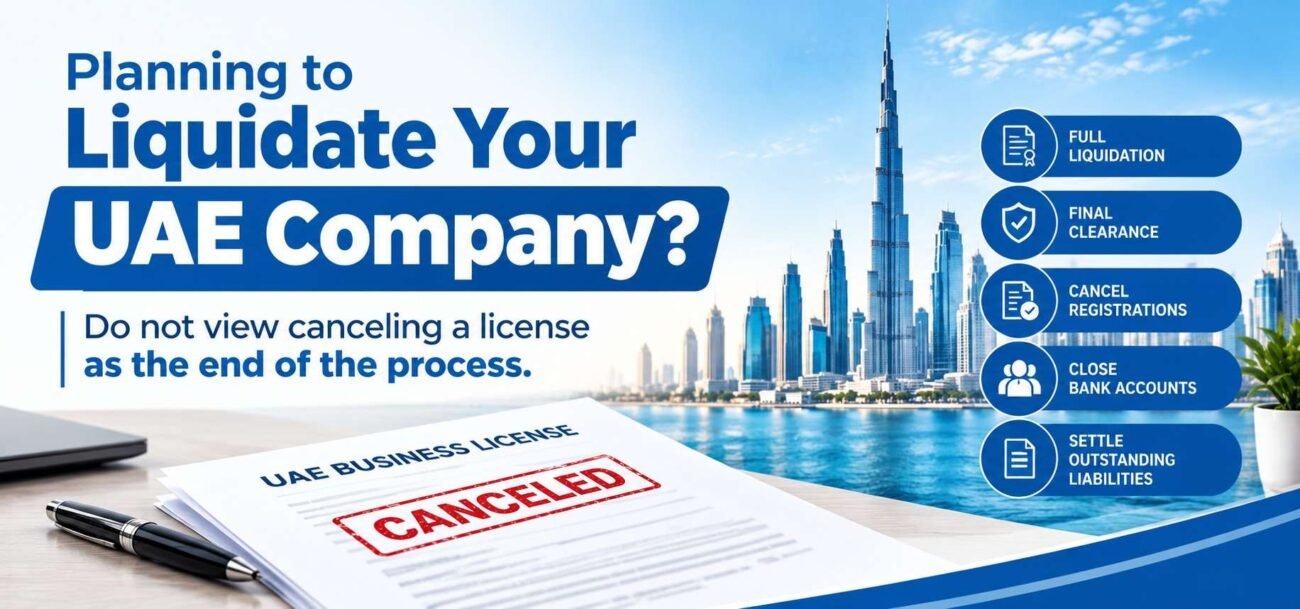
Closing a business in the UAE often feels like it should end with a single piece of paper: the cancelled trade licence. Plenty of founders assume that once that certificate lands in their inbox, the company has legally
vanished and every obligation has gone with it. Unfortunately, it doesn’t work like that. Terminating your
license simply lets the government authority know you are shutting down. Meanwhile, your tax
department, banks, workers, landlords, and lenders will likely still consider your company active.
Overlooking them can lead to fines, blocked applications and even personal exposure for owners and
managers.
In this guide, the team at iRhabiz explains what a complete UAE company liquidation actually involves, why
the licence is only one milestone along the way, and how to wind up your business without leaving loose
ends behind.
Key Takeaways
- Licence cancellation is one step of liquidation, not the finish line.
- VAT and Corporate Tax registrations stay open with the Federal Tax Authority (FTA) until you formally deregister.
- Visas, labour records, bank accounts, lease and creditor claims all need to be closed properly.
- Mainland and free zone companies follow different procedures, but both need tax and labour clearances.
- Professional planning saves time, avoids penalties and protects directors and shareholders.
Licence Cancellation vs. Company Liquidation: Are They the Same?
Mistaking one for the other is actually the most typical mistake that leads to legal or financial headaches later on. Think of the licence as your permission to trade, and liquidation as the legal process of ending the company itself.
| Area | Licence Cancellation | Company Liquidation |
|---|---|---|
| Main purpose | Ends your permission to operate under the licence | Legally winds up the company and settles its affairs |
| Creditors and debts | Not addressed | Claims are invited, verified and settled |
| Tax registrations | Not cancelled automatically | VAT and Corporate Tax deregistration completed |
| Employees | Partly (visa cancellation) | Final dues, visas and labour records fully closed |
| Remaining assets | Not addressed | Distributed to shareholders after liabilities are paid |
What Can Go Wrong If You Stop at Licence Cancellation?
Walking away after the licence is cancelled can leave several doors open at once:
- Active tax registrations. Your VAT and Corporate Tax registrations will stay active until official deregistration is granted. Returns may stay due, and penalties can keep growing even though the business has stopped trading.
- Unsettled creditors. Suppliers, landlords or lenders can still raise claims, and directors or shareholders may be dragged into the dispute.
- Labour and visa problems. Unpaid end-of-service dues or uncancelled residence visas can trigger complaints and fines.
- Banking and legal exposure. Open accounts, guarantees or post-dated cheques can lead to disputes long after closure.
- Trouble starting again. Unresolved liabilities can complicate your next company registration in the UAE, for you and your partners.
How to Liquidate a UAE Company: Step-by-Step Breakdown
The exact route depends on whether you hold a mainland or free zone licence, but a typical liquidation follows this order.
Step 1: Shareholders Pass a Dissolution Resolution
The owners formally decide to dissolve the company and record that decision in a written resolution.
Step 2: Appoint a Liquidator
A licensed liquidator, usually an approved professional or firm, takes charge of winding up the business and represents it during the process.
Step 3: Publish the Liquidation Notice
A public notice invites creditors to submit claims. For mainland companies, a creditor notice period of around 45 days is generally observed, and it cannot be shortened.
Step 4: Settle Liabilities and Close the Books
Debts, supplier invoices, rent and staff entitlements are cleared, and the liquidator prepares the final financial statements and report.
Step 5: Clear Employees and Visas
Debts, supplier invoices, rent and staff entitlements are cleared, and the liquidator prepares the final financial statements and report.
Step 6: Complete Your VAT and Corporate Tax Deregistration
This is the step most owners overlook. Both taxes are handled through separate applications to the FTA, covered in detail in the next section.
Step 7: Collect Lease, Utility and Bank Clearances
End your lease agreement, deactivate utility services, and request clearance certificates from your banks. These documents are usually required for the final submission.
Step 8: Cancel Trade Licence and De-register the Company
Once the liquidator’s report and all clearances are approved, the licensing authority (such as the Department of Economy and Tourism or your free zone) cancels the licence and removes the company from its register.
Tax Deregistration: The Step Most Owners Miss
Ceasing trading, cancelling a licence and deregistering for tax are three different things. Completing one does not complete the others.
- VAT: If you are VAT-registered, a deregistration application is generally expected within a short window (about 20 business days) after you stop making taxable supplies. Final returns must be filed and any balance paid.
- Corporate Tax: This is a separate application. It is generally required within a set period after cessation or dissolution (commonly cited as around three months). Procedures and timelines can be updated by the FTA, so confirm the current rule before you file.
- Penalties: Late deregistration can attract administrative penalties that start at a fixed amount and increase month by month up to a ceiling.
- Sequencing: Plan tax deregistration alongside the liquidation instead of leaving it for the end. Final returns and clearances are often needed before the licence can be cancelled, so agree the order with your liquidator.
Mainland vs. Free Zone Liquidation
• Mainland: Usually involves a licensed liquidator, a creditor notice period, a liquidator’s report and clearances from several government bodies.
• Free zone: Each zone has its own forms, fees and timelines, but tax deregistration and labour and visa clearances still apply.
Always confirm the procedure with your specific licensing authority before you begin.
How Long Will It Take and What Are the Expenses?
A properly managed liquidation commonly takes two to three months or more, depending on the creditor notice period, pending visa and tax matters and the state of your records. The total cost depends on:
• The licensing authority and type of licence
• Liquidator and professional service fees
• Government charges and newspaper notice fees
• Employee settlements and visa cancellation costs
• How complex your accounts and liabilities are
Because every company is different, it is better to request a quote based on your actual situation than to rely on generic figures you find online.
Six Mistakes to Avoid When Closing a UAE Company
1. Letting the licence lapse instead of liquidating formally.
2. Cancelling the licence first before visas and taxes are sorted.
3. Forgetting Corporate Tax deregistration after dealing only with VAT.
4. Failing to settle pending liabilities with staff, landlords, or service providers.
5. Poor record-keeping, which slows every clearance.
6. Going it alone. A single oversight can force you to restart the entire process.
Your Pre-Closure Checklist
☐ Shareholders’ resolution passed and liquidator appointed
☐ Creditor notice published and notice period completed
☐ All debts, rent and employee dues settled
☐ Visas and labour cards cancelled
☐ Final VAT and Corporate Tax returns filed
☐ VAT and Corporate Tax deregistration completed
☐ Bank, utility and landlord clearances received
☐ Liquidator’s final report approved
☐ Trade licence cancelled and company removed from the register
How IRHA Businessmen Services Delivers Compliant and Structured Business Dissolution
Winding up a company deserves the same care as setting one up, because a small oversight can follow you for years. IRHA Businessmen Services supports business owners through the entire liquidation journey: liquidator coordination, creditor notices, visa and labour clearances, VAT and Corporate Tax deregistration, and final licence cancellation, for both mainland and free zone companies.
With the right plan in place, you avoid unnecessary penalties, delays and legal exposure, and you can move on to your next venture with a clean record.
Frequently asked questions
No. Cancelling the licence only ends your permission to trade. A proper closure also requires settling creditors and staff dues, closing your tax registrations with the Federal Tax Authority, cancelling visas and obtaining clearances from the relevant authorities.
In most cases, yes. A company registered with the FTA stays on its records, with filing duties attached, until a deregistration application is approved, even when no revenue was generated.
For most mainland companies, a liquidator is needed to supervise the winding-up. Free zones set their own rules, so check with your licensing authority before you begin.
The company may remain on government records, penalties can keep accumulating and tax deadlines continue to run. This can create obstacles for you and your partners when you apply for new licences later.
Most cases take around two to three months at the minimum and sometimes longer. Your total timeline will be governed by several variables, including the mandatory creditor notification duration, visa processing, tax clearance approvals, and document readiness.
Yes, but the debts must be handled through the formal process. The liquidator settles liabilities in line with the law, so it is wise to take professional advice early.
Is free zone liquidation different from mainland liquidation? Procedures, forms and fees differ from one free zone to another, but tax deregistration and labour and visa clearances still apply in both cases.