
Why a Business Bank Account Application Can Be Delayed — And What You Can Prepare
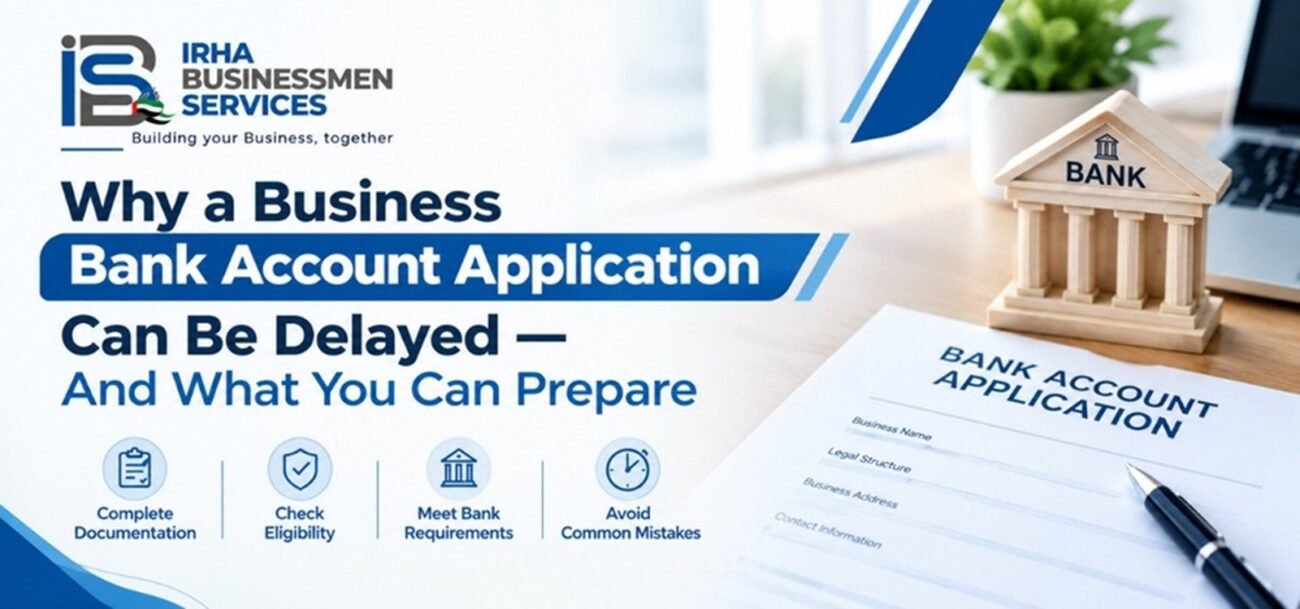
This IRHA Businessmen Services banner highlights common challenges businesses may face when applying for a bank account. Featuring a bank account application form and a miniature bank building, the image emphasizes four key preparation steps: completing documentation, checking eligibility, meeting bank requirements, and avoiding common mistakes to support a smoother application process.
Why banks take their time
A corporate bank account serves a greater purpose than merely holding cash. It lets you invoice clients, pay suppliers and run payroll, so a company without one cannot really operate. For the bank, though, every new account is a risk decision. UAE banks must complete know-your-customer (KYC) and anti-money-laundering checks on the company, its owners and its controllers before they open anything. That review is thorough by design, and any open question pauses the clock.
It also helps to know that opening an account is always the bank’s decision. No consultant, free zone or agent can promise approval. Document accuracy and quality remain entirely within your jurisdiction.
Common reasons an application gets delayed
1. Documents that do not match
A name spelled two ways, an address that differs between the licence and the lease, or a signature that does not look like the one on the passport can all trigger a query. Individually these look minor. To a compliance officer, they are reasons to stop and ask.
2. Missing or incomplete paperwork
Forgetting a board resolution, an expired document, or an unattested certificate for a corporate shareholder sends the file back to you. Each round of questions can add days.
3. A vague or mismatched business activity
If your licence says one thing and your explanation says another, the bank will want clarity. Describe what you sell, who buys it, which countries you deal with and how money will move. Short, plain language works better than broad phrases like “general trading” without details.
4. Unclear source of funds and source of wealth
Banks want to understand where the starting capital came from and how the owners built their wealth. If your answer is thin or cannot be supported with documents, the review slows down. This is a leading factor behind requests for supplementary information.
5. Weak proof of real business activity
A new company with no contracts, quotations, invoices, website or client pipeline can look like a shell. Banks like to see commercial substance: a realistic plan, expected transaction volumes and some evidence that you are open for business.
6. Complex ownership structures
When shares are held through several companies or in different countries, the bank has to trace every layer to the ultimate beneficial owners. Missing registers, unattested documents or inconsistent UBO details make that tracing slow.
7. Higher-risk activity, countries or customers
Some industries and jurisdictions attract closer review. That does not mean you will be refused, but the file may need more explanation, more evidence and more time.
8. Limited physical presence
Banks often prefer to see some local footprint, such as a real office arrangement, a UAE-based signatory or a resident contact. Running a business purely online without regional ties frequently invites closer scrutiny.
9. Applying to the wrong bank
Banks differ in the profiles they like, the minimum balances they ask for and the sectors they are comfortable with. Sending a small start-up to a bank that focuses on large corporates is a quick way to lose weeks.
What you can prepare before you apply
Banks set their own checklists, so always confirm the latest list with the bank you choose. The table below shows what is usually requested.
| Area | What to Have Ready |
|---|---|
| Company Documents | Valid trade licence, incorporation documents, memorandum or articles of association, lease or office proof, share certificates, and board resolution for the account and signatories. |
| Owners and Signatories | Passports, Emirates ID and residence visa where applicable, proof of address, CVs or profiles, and specimen signatures. |
| Corporate Shareholders | Attested incorporation documents, register of shareholders and directors, UBO details, and group structure chart. |
| Business Story | Short business plan, description of products or services, customer and supplier profile, countries involved, expected monthly turnover, and transaction types. |
| Funds | Evidence of source of funds and source of wealth, such as bank statements, sale agreements, salary history, or audited accounts. |
| Proof of Activity | Contracts, quotations, purchase orders, invoices, website, and client references where available. |
A simple preparation routine
- Finish your company formation and collect the original, valid documents.
- Cross-check every name, address, date and signature across all papers.
- Write a clear one-page business profile in plain language.
- Gather proof of funds and proof of business activity.
- Shortlist banks that match your size, sector and ownership type.
- Ensure every designated signatory is fully briefed to provide consistent answers to the bank.
- Submit a complete file, then reply to follow-up requests quickly.
How long should you expect to wait?
There is no fixed answer. A clean, simple file at a bank that suits your profile can move in a few weeks. Files with several owners, foreign companies, higher-risk activity or missing papers can take a couple of months or longer. Planning for the longer end avoids pressure, especially if you need the account to pay staff or receive your first customer payments.
While you wait: keep the business moving
- Keep records and invoices organised so you can show activity later.
- Check whether a digital or business-friendly account can serve as an interim solution, if it suits your needs and the rules of your free zone or licence.
- Respond to every bank query within a day or two. Silence is one of the biggest causes of avoidable delay.
- Avoid submitting parallel applications without a plan, because repeated rejections can make the next attempt harder.
If your application is declined
Receiving an initial turn-down does not preclude future approval or alternative solutions. Ask what the concern was, fix the gap (for example, clearer activity details or stronger proof of funds), and consider a bank that better matches your profile before reapplying. Many “soft” rejections come down to incomplete or inconsistent information that can be corrected.
Pre-application checklist
- Trade licence valid and activity matches what you will explain to the bank
- All names, addresses and signatures consistent across documents
- Board resolution and signatory details ready
- Corporate shareholder documents attested and UBO chart prepared
- Source of funds and source of wealth evidence collected
- Business plan and expected transactions written clearly
- Proof of activity (contracts, quotations, invoices, website) available
- Bank shortlisted based on profile fit
- Account signatories have been prepared and are accessible for upcoming discussions or interviews
Frequently asked questions
Timelines depend on bank requirements and your business standing. Simple files can move in a few weeks, while complex structures or missing documents can take a couple of months.
The bank may still be verifying details, tracing ownership, reviewing source of funds or waiting for clarification on your activity. Quick, consistent replies help.
Often yes, but expect to provide a clear business plan, expected transaction details and some evidence of commercial intent.
It can. Banks consider the activity, the jurisdiction and the substance of the business, so your set-up should make sense for how you plan to operate.
No. The bank decides. A good adviser helps you prepare a strong file and approach a suitable bank, but cannot guarantee the result.
Not without a plan. Choose banks that fit your profile and apply deliberately, because repeated declines can complicate later attempts.