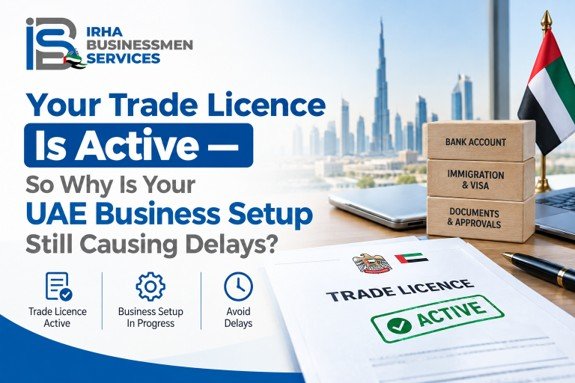
Your Trade Licence Is Active — So Why Is Your UAE Business Setup Still Causing Delays?
Book Your Free Consultation
Introduction
Having an active UAE trade licence does not automatically mean that every part of a company’s government and immigration record is ready for the next transaction. A trade licence confirms that a business is authorised to conduct its registered activity. It does not, by itself, confirm that the company’s immigration file, ownership records, approvals, or supporting documents are all current and consistent.
This distinction can become important when a company tries to arrange a visa, make a corporate amendment, update its records, or complete another government-related process. The licence may appear completely valid while another connected record creates an unexpected obstacle.
A UAE business setup therefore needs to be viewed as a connected chain of records rather than as a single licence. The following areas are worth reviewing when a transaction is delayed even though the company’s licence remains active.
Why an Active Trade Licence May Not Be Enough
A UAE company can have several separate government records supporting its operations. These records are connected, but an update made in one system does not necessarily update every other record automatically.
Depending on the company’s structure and location, the overall record may include:
- The trade licence issued by the Department of Economic Development (DED) or the applicable free zone authority.
- The establishment card or company immigration file maintained through GDRFA in Dubai or ICP at the federal level and in the relevant emirates.
- Labour records maintained through MOHRE for applicable mainland employers.
- Ownership, management, partner, and authorised-signatory information recorded through the licence, Memorandum of Association (MOA), and immigration records.
A change in ownership, company address, business activity, or another corporate detail can therefore leave different records showing different information. When a new transaction depends on those records matching, the inconsistency may only become visible at the time of application.
Establishment Card and Immigration File: Is Everything Still Current?
The establishment card, also referred to as the Company Immigration Card (CIC), connects the company to the immigration system and is important for visa sponsorship and related transactions. It is maintained separately from the trade licence and may require renewal.
If the establishment card has expired, was not renewed, or contains information that no longer corresponds with the current licence, an immigration transaction can be delayed even when the trade licence remains active.
Before assuming that a visa or immigration delay is simply a government processing issue, a company can check:
- Whether the establishment card is currently valid.
- Whether the company name, licence number, and activity correspond with the latest trade licence.
- Whether the immigration record was updated after the most recent licence renewal or amendment.
Keeping these records aligned can reduce avoidable problems during visa processing.
Company and Shareholder Records: Do All Documents Show the Same Information?
Ownership and management information can appear across several corporate records, including the trade licence, MOA, Chamber of Commerce registration, and immigration file. If a partner, shareholder, manager, or authorised signatory has changed but the update was not completed across the relevant records, a transaction requiring ownership or signatory verification may be held up.
For example, a change in partners can require a formal resolution and corresponding updates to corporate documents. Depending on the circumstances, this may involve an amended MOA or MOA addendum, Chamber of Commerce records, and relevant beneficial ownership information.
The important point is consistency. Completing a resolution or signing an amendment is not necessarily the final step. The change also needs to be formally registered wherever the authority requires it. If one record still contains previous information, the mismatch can become an issue when the company submits its next application.
Business Activities and Regulatory Approvals: Is Additional Permission Required?
Not every business activity follows the same approval process. Some activities can be handled through the licensing authority, while others may require clearance from a separate government or regulatory body before the requested change can be processed.
This can be particularly relevant to regulated areas such as financial services, healthcare, education, media, and security-related activities. Similar issues may arise when a company adds a regulated activity, changes an address that affects zoning requirements, or modifies its legal structure.
If an approval is required but has not been obtained, or if an earlier approval is no longer valid, the licensing authority may not be able to complete the requested transaction. In such cases, the trade licence itself may not reveal the underlying problem.
Visa Eligibility and Quota: Does the Company Support the Requested Visa?
Visa processing depends on more than the existence of an active trade licence. The relevant immigration file, labour quota, activity classification, ownership information, and supporting documents all have a role depending on the type of visa being requested.
Employment visa capacity can be affected by factors such as office space, business activity, and applicable labour requirements. Investor and partner visa applications may depend on whether the applicant’s ownership information matches the company’s official records. Dependent visas can depend on the sponsor’s status and applicable salary or accommodation requirements.
Golden Visa applications have their own eligibility and documentation requirements. Meeting a general eligibility category does not necessarily mean that all supporting evidence is prepared in the form required for the application.
Because these issues can become visible only when a specific application is submitted, checking the relevant records in advance can help identify potential gaps earlier.
Corporate Amendments: Were All Changes Completed in the Correct Order?
Changes involving shareholders, managers, business activities, or registered addresses normally need to be formally recorded with the appropriate authority. Depending on the change, updates may also be required with the Chamber of Commerce, immigration authorities, FTA, or MOHRE.
For ownership changes, the required process may include a formal resolution, updated corporate documentation, notarisation, and other steps depending on the emirate or free zone. Some cases may also involve publication requirements before the amended licence is issued.
A registered address change can similarly require official notification and updates to connected records. If an amendment is only partially completed, the old information may continue to appear in one of the supporting systems.
Attempting a new transaction before the earlier amendment has been fully completed can therefore create another delay. Completing each update before moving to the next transaction helps maintain consistency throughout the company’s records.
Supporting Documents and Compliance: Are They Still Valid?
A valid trade licence does not guarantee that every supporting document remains acceptable for a new transaction. Corporate, immigration, identification, tenancy, and other documents can have their own validity periods or authentication requirements.
Examples may include:
- A tenancy agreement or Ejari that no longer corresponds with the registered company address.
- An expired passport or Emirates ID copy.
- A Certificate of Good Standing for a corporate shareholder that requires renewed attestation.
- A document that was submitted without the notarisation or MOFA legalisation required for the relevant process.
These documents often sit behind the main licence record, which makes their status easy to overlook. A problem may only become obvious when a new transaction requires the document again.
Look at the Entire Business Setup Chain
When a UAE company experiences a delay despite having an active licence, the licence should not be the only record reviewed. A broader check can help identify where the inconsistency actually exists.
A useful way to view the process is:
Trade Licence → Establishment Records → Immigration File → Eligibility → Approvals → Supporting Documents → Transaction A successful UAE business setup is not simply about obtaining a licence. It also involves maintaining the related records, approvals, and compliance documents throughout the company’s lifecycle.
Trade Licence → Establishment Records → Immigration File → Eligibility → Approvals → Supporting Documents → Transaction A successful UAE business setup is not simply about obtaining a licence. It also involves maintaining the related records, approvals, and compliance documents throughout the company’s lifecycle.
If a company is unsure where the problem is, reviewing the licence, immigration file, ownership information, approvals, and supporting documents together can make it easier to identify the specific gap. Business setup and PRO support services can assist companies in reviewing these connected requirements before another application is submitted.
Frequently Asked Questions
Not necessarily. A trade licence confirms that the company is authorised for its registered activity, but other records are maintained separately. Immigration status, ownership information, regulatory approvals, and supporting document validity may still require attention.
The establishment card, also known as a Company Immigration Card (CIC), is the company’s record with the relevant immigration authority. It is important for visa sponsorship and related immigration transactions. If it has expired or contains information that does not match the company’s current records, visa processing can be affected.
Possible reasons include an expired or inconsistent establishment card, differences in shareholder or authorised-signatory information, missing regulatory approval, insufficient visa quota, or incomplete supporting documentation. The trade licence alone does not display all of these conditions.
A shareholder or partner change generally needs to be formally documented and registered with the relevant authorities. Depending on the case, this can involve a resolution, an updated MOA or MOA addendum, Chamber of Commerce records, and immigration records. The exact requirements can vary by jurisdiction and company structure.
No. Some activities can be added through the licensing authority, while regulated activities may require approval from another government or industry authority before the licence can be amended.
An expired establishment card can affect new visa and immigration transactions connected to the company file. Late renewal may also result in recurring fines according to applicable immigration rules.
No. Eligibility and documentation are separate considerations. An applicant may meet the general category requirements while still needing current evidence such as licence records, investment or capital verification, bank or fund documentation, and applicable attestations.
Start by checking the trade licence, establishment card, ownership and signatory details, pending approvals, and key supporting documents. Comparing these records before submitting another transaction can help identify inconsistencies. A professional review can also help confirm which record needs updating.
The underlying principle applies to both. Mainland and free zone companies have licensing, immigration, ownership, and amendment requirements, although the responsible authority and exact procedure can differ.
A business setup consultant or PRO services provider can review the connected records together, including the trade licence, establishment card, ownership information, approvals, and supporting documents. This can help identify the specific issue instead of treating each record as an isolated problem.