
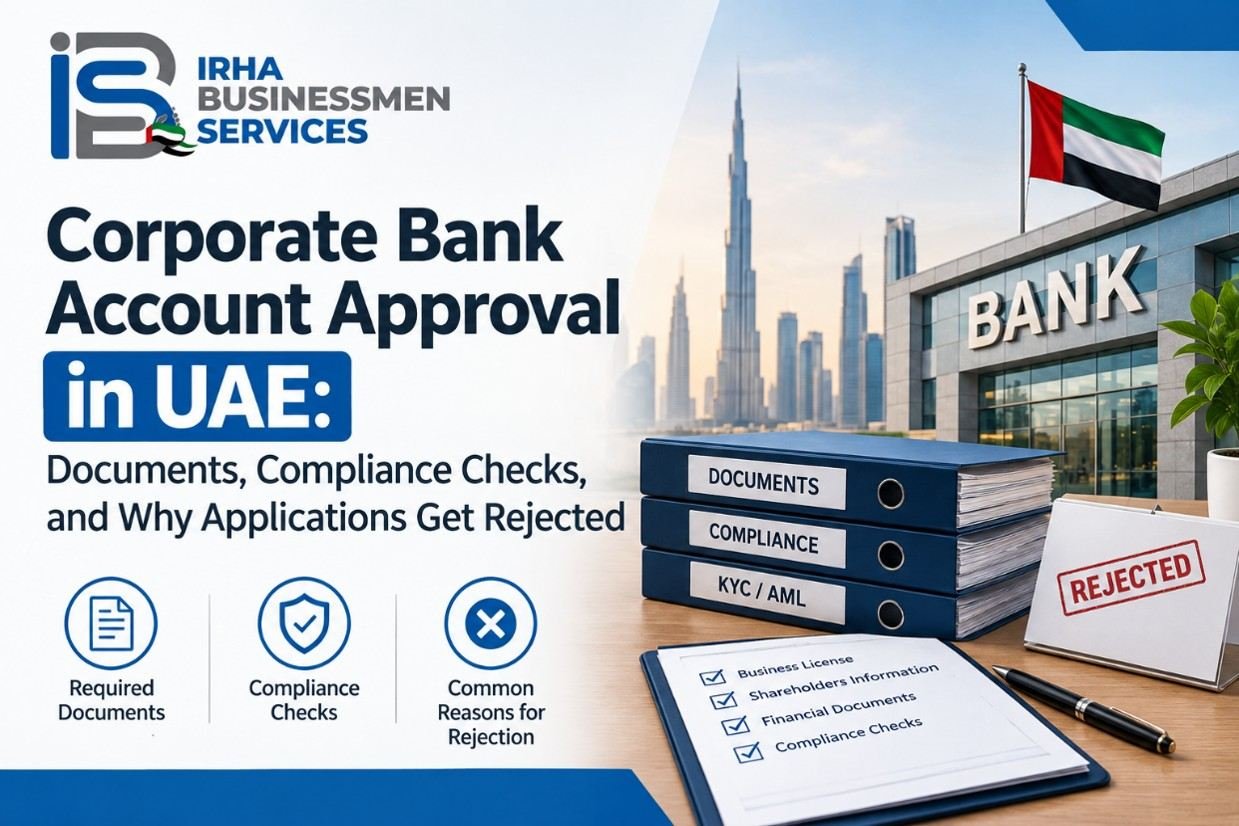
Corporate Bank Account Approval in UAE: Documents, Compliance Checks, and Why Applications Get Rejected
Book Your Free Consultation
A trade licence only proves that your company exists legally. Whether a bank will open an account is a separate decision, and it depends on how clearly the bank can understand and verify your company, its owners and the money that will move through it. Corporate bank account approval in UAE is therefore a risk assessment as much as a paperwork exercise.
This guide explains what banks look at, which documents to prepare, how UBO disclosure fits in, and the most common reasons applications are declined. It also covers what to do if yours is turned down. Requirements differ from bank to bank, so use this as a preparation framework, not a guarantee of approval.
What UAE Banks Check Before Approving a Corporate Account
UAE banks operate under Central Bank rules and international anti-money-laundering standards. Before onboarding a company, they must establish who owns it, how it earns money, where its funds come from, and whether the activity you expect on the account creates any regulatory or financial risk.
In practice, most reviews come down to five questions:
- Ownership: who actually owns and controls the company?
- Activity: what does the business do, and does it match the licence?
- Funds: where does the starting capital come from, and where will future income come from?
- Substance: does the company have a genuine presence in the UAE?
- Expected activity: which countries, customers and suppliers will the account deal with, and at what volumes?
Banks also differ in the customers they prefer. Some favour companies with a trading history, and international banks may follow the stricter standards of their parent group. Choosing a bank that fits your profile matters almost as much as the file itself.
Documents Needed for a UAE Corporate Bank Account
Every bank publishes its own list, but the following items appear on most of them.
Company documents
- Trade licence and Memorandum of Association. These form the core of any application.
- Proof of a physical address: an Ejari-registered tenancy contract for mainland companies, or the lease issued by the free zone authority for free zone companies.
- Board resolutions and attested copies where the bank or free zone asks for them.
Owner and signatory documents
- Passport copies and address proof for shareholders and directors.
- A UBO declaration naming the individuals behind the company.
- Professional CVs. Some banks also ask for recent personal or company bank statements, and many want at least one signatory to hold UAE residency.
Business and financial proof
- A clear business plan or activity description.
- Contracts, invoices, supplier agreements or purchase orders, depending on your sector.
- A source-of-funds explanation with evidence, and for some profiles, source-of-wealth details.
UBO Disclosure and Compliance: The Step That Slows Most Files
The ultimate beneficial owner (UBO) is the real person behind a company. Under Cabinet Decision No. 109 of 2023, that includes anyone who holds 25% or more of the capital or voting rights, directly or through a chain of entities, as well as anyone who controls the company by other means, such as the power to appoint or remove most of its directors.
Banks are not limited to that 25% line. Central Bank guidance allows institutions to look at smaller shareholders where risk calls for it, and to ask for the names of every individual holding any stake. If your structure includes holding companies or several layers, prepare a simple ownership chart that ends at named individuals. Also keep your official UBO records current, because changes in ownership must be reported to the registrar within a short window.
Common Reasons UAE Banks Reject Corporate Account Applications
Banks rarely spell out their reasoning, so the list below is best read as a set of likely causes.
- Incomplete KYC or UBO paperwork. If the bank cannot identify who stands behind the company, the file stalls.
- A mismatch between documents. The licence describes one activity while the business plan, website or contracts describe another. Banks compare what you tell them with other data sources, so every document should tell the same story.
- A thin source-of-funds explanation. Banks need to see where the money originates and how it will flow through the account.
- Complex or opaque ownership. Layered structures, or owners connected to higher-risk jurisdictions, attract closer scrutiny.
- Little visible UAE presence. Many banks want a genuine lease and may question virtual-office addresses.
- A vague business plan. Generic wording gives the bank nothing to assess.
- Applying to the wrong bank. A sound file can still fail at an institution that does not serve your sector or ownership profile.
How to Prepare a Stronger Application
- Align your licence activity, business plan, website and contracts before you apply, and correct any inconsistency.
- Prepare an ownership chart that traces every layer to individuals.
- Write a short source-of-funds note and attach supporting evidence.
- Describe expected activity: main customers, suppliers, countries and approximate monthly volumes.
- Make sure documents are current, complete and properly attested.
- Shortlist banks suited to your sector, ownership and turnover instead of applying to many at once.
A free zone licence does not give you a shortcut. Banks apply their own KYC and AML review to every applicant, and an introduction from a free zone authority does not replace that review.
What to Do After a Rejection
Reapplying straight away rarely helps. Ask the bank for whatever feedback it is willing to give, then compare your file against the causes listed above. Once you have found the gap, correct it and approach a bank that matches your profile with a stronger application. A rejection usually points to a fixable file or fit problem, not a permanent barrier.
Getting Support With Corporate Bank Account Opening
If your case involves foreign shareholders, layered ownership or your first UAE company, a professional review before submission can save weeks. IRHA Businessmen Services supports the steps around banking, including mainland company setup and corporate bank account opening support. The decision always rests with the bank, but a well-prepared file gives it fewer reasons to hesitate.
Frequently Asked Questions
Usually because they could not verify ownership, business activity or source of funds. Incomplete KYC, mismatched documents and weak UAE substance are the recurring causes.
Typically the trade licence, Memorandum of Association, shareholder and director passports, a lease or Ejari, a UBO declaration and a business description. Banks may also request contracts, statements and source-of-funds evidence.
It varies by bank and by how complex your structure is. There is no reliable official timeline, so ask the bank directly and allow extra time for foreign-owned or layered structures.
Yes, but fix the cause first. Sending the same file to another bank without changes tends to produce the same result.
No. The bank’s own KYC and AML checks apply whatever the licence type.
The individual who owns or controls 25% or more of a company, or who controls it by other means, under Cabinet Decision No. 109 of 2023.
Often yes, but expect enhanced due diligence. Many banks want at least one UAE-resident signatory and some require an in-person meeting, so confirm with each bank.
Many banks set one, and the amount differs by bank and account tier. Check current terms before you apply.